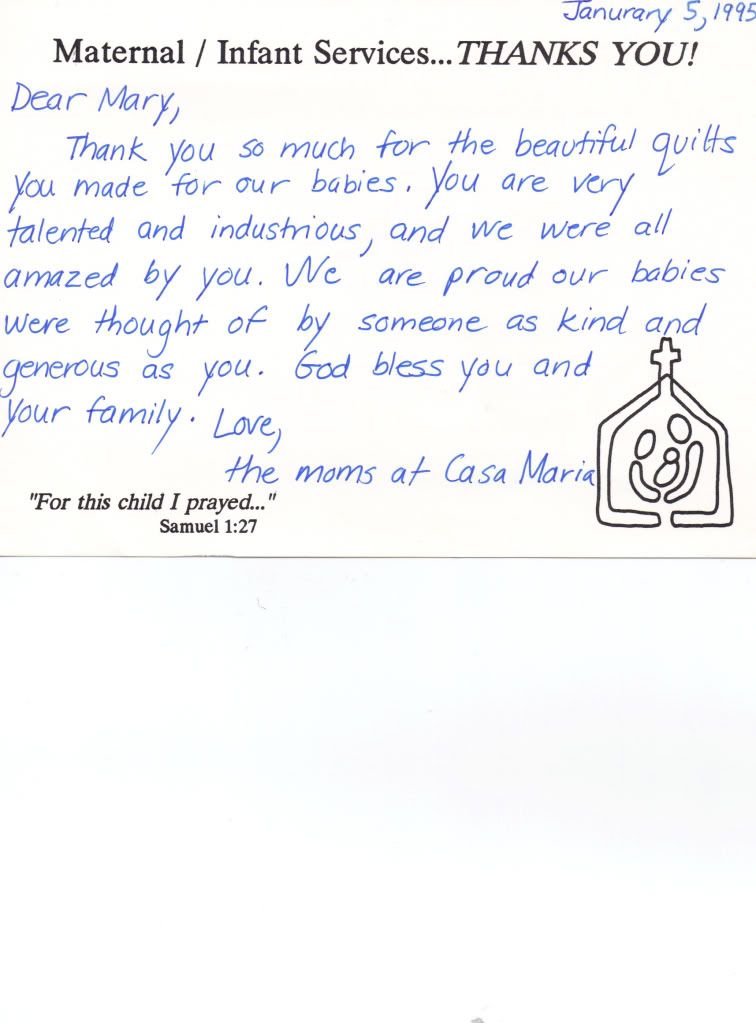
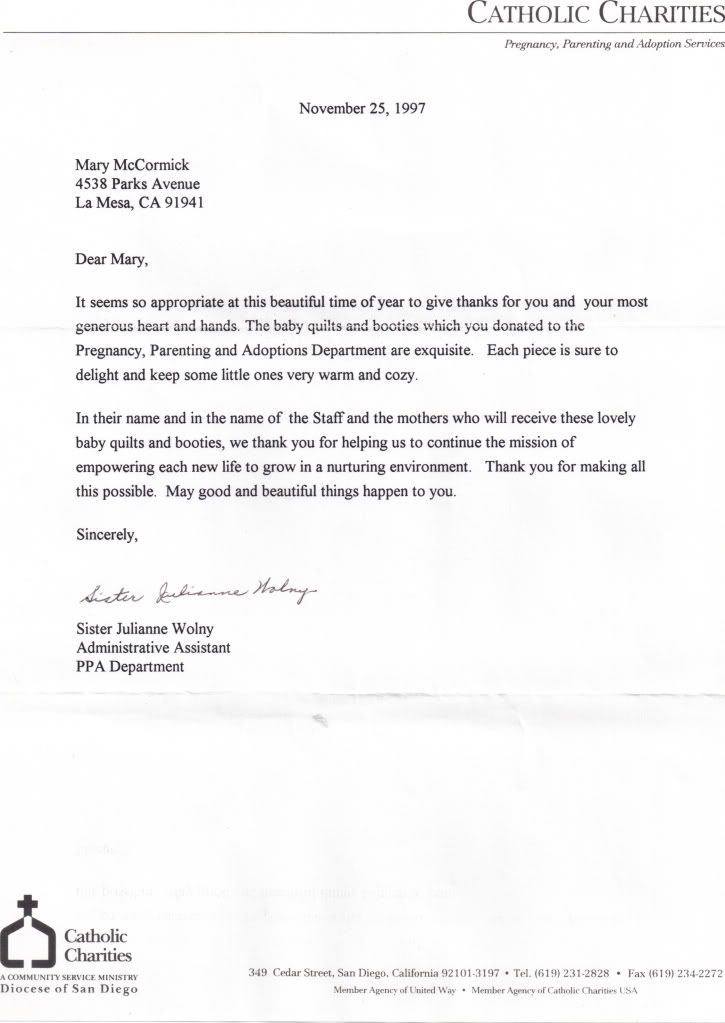
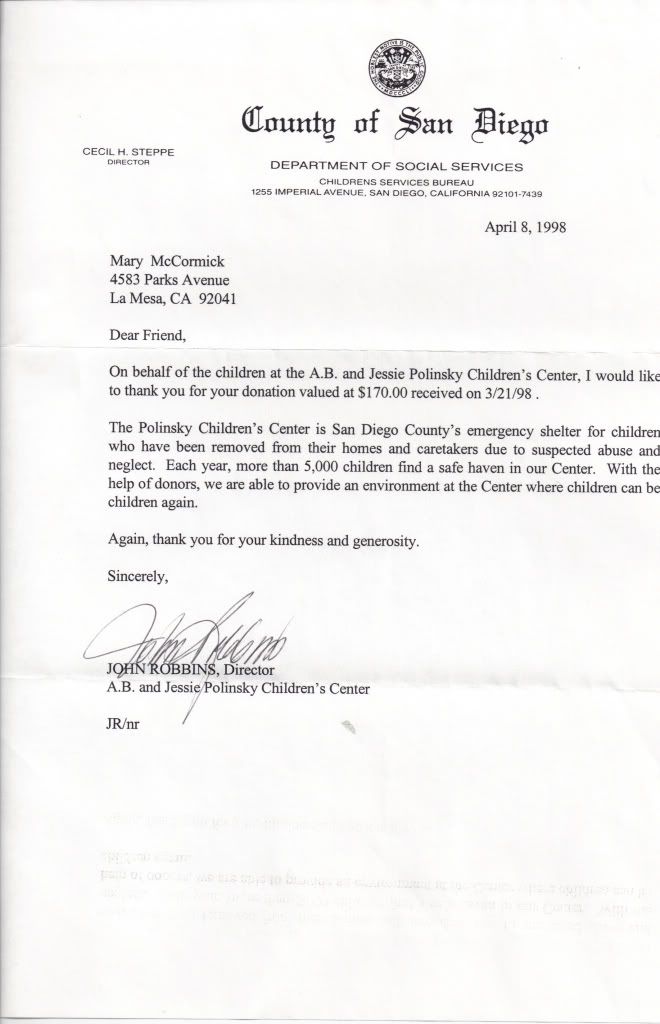
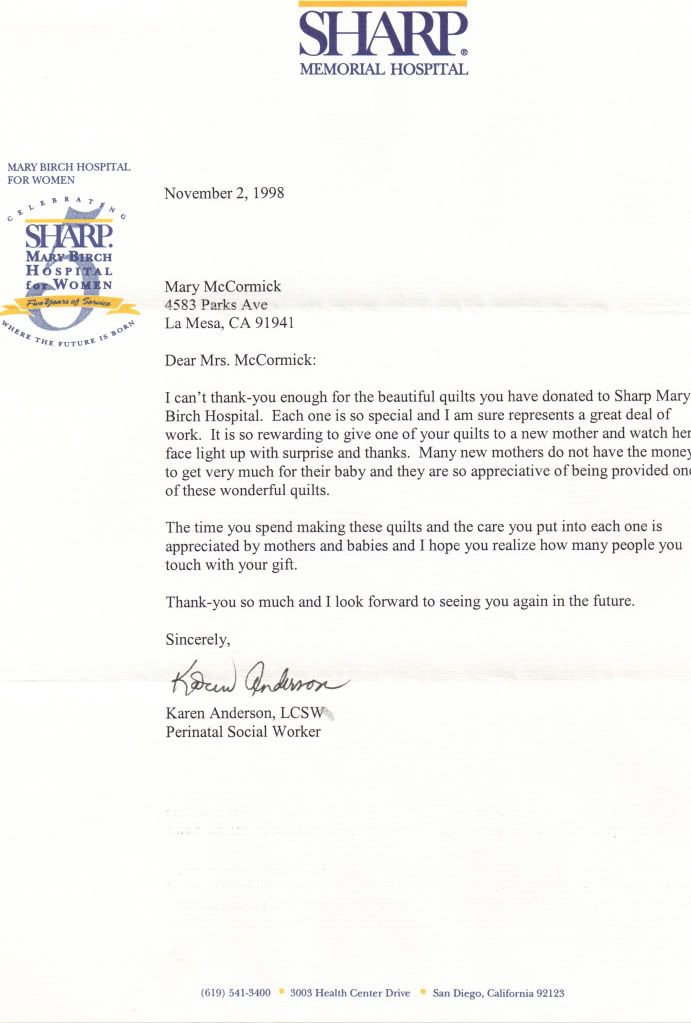
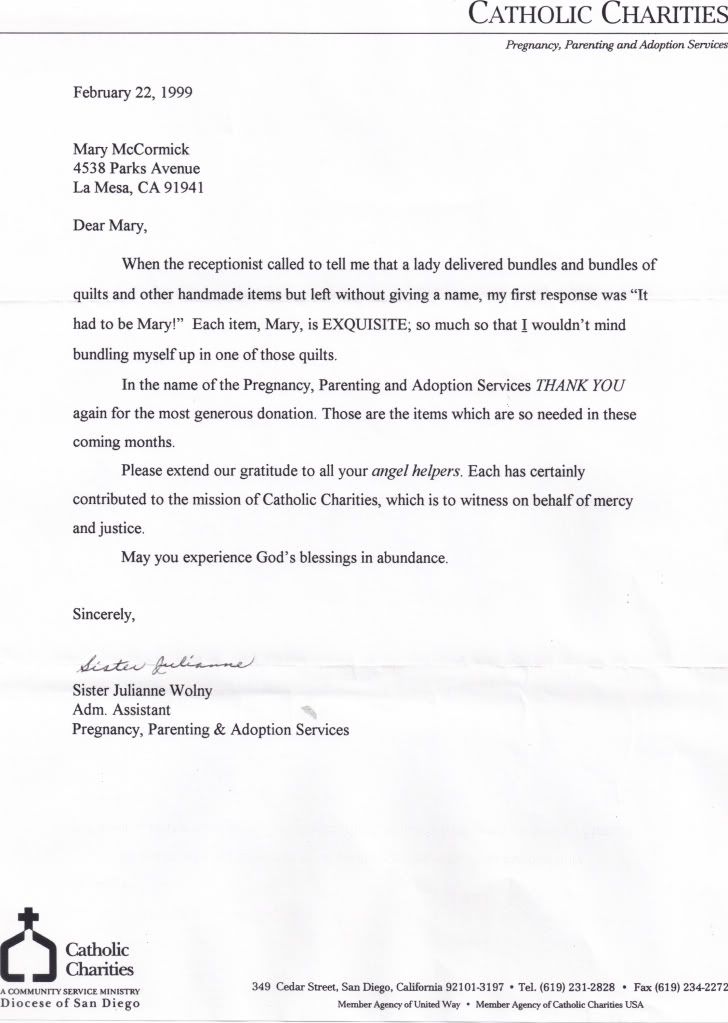
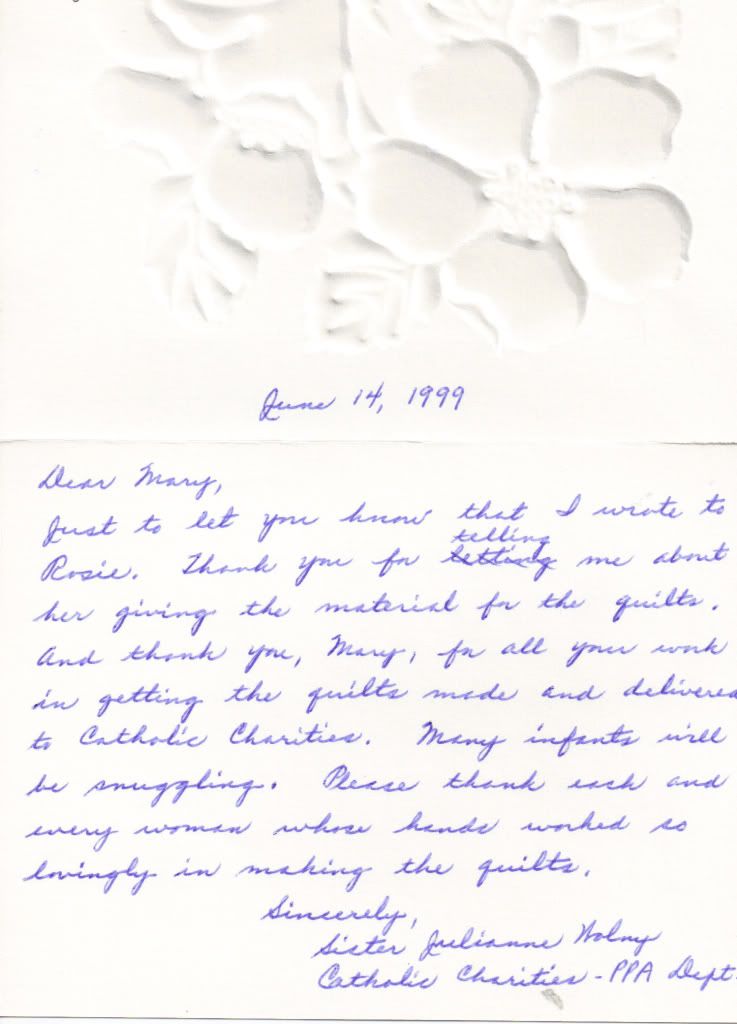
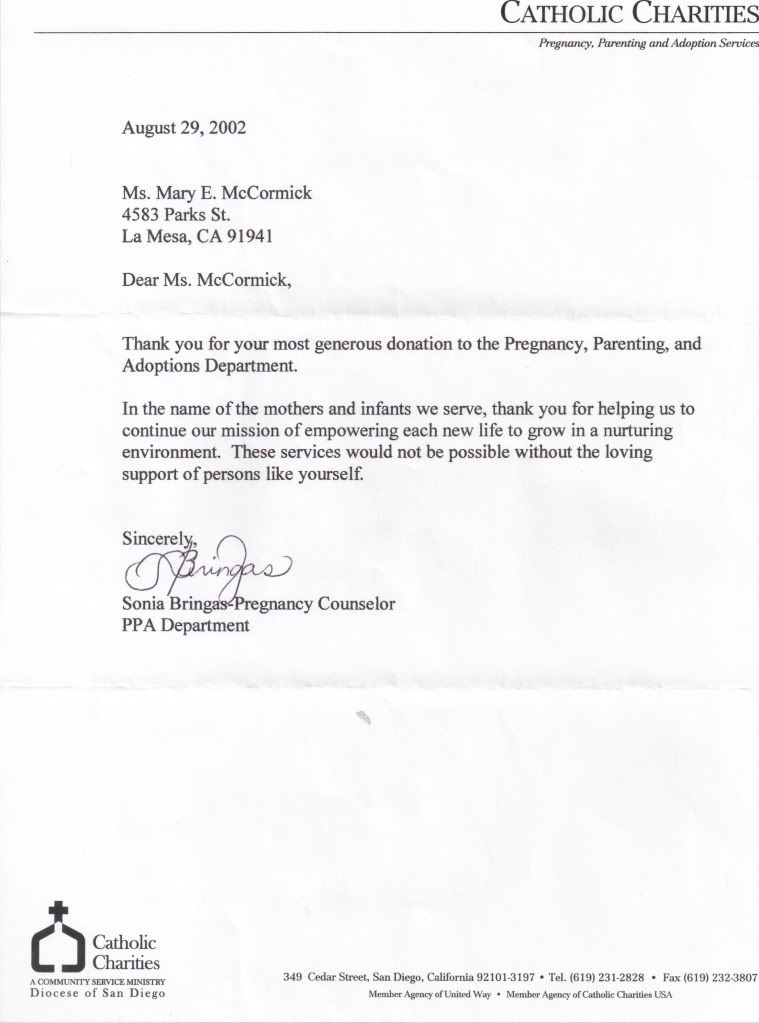
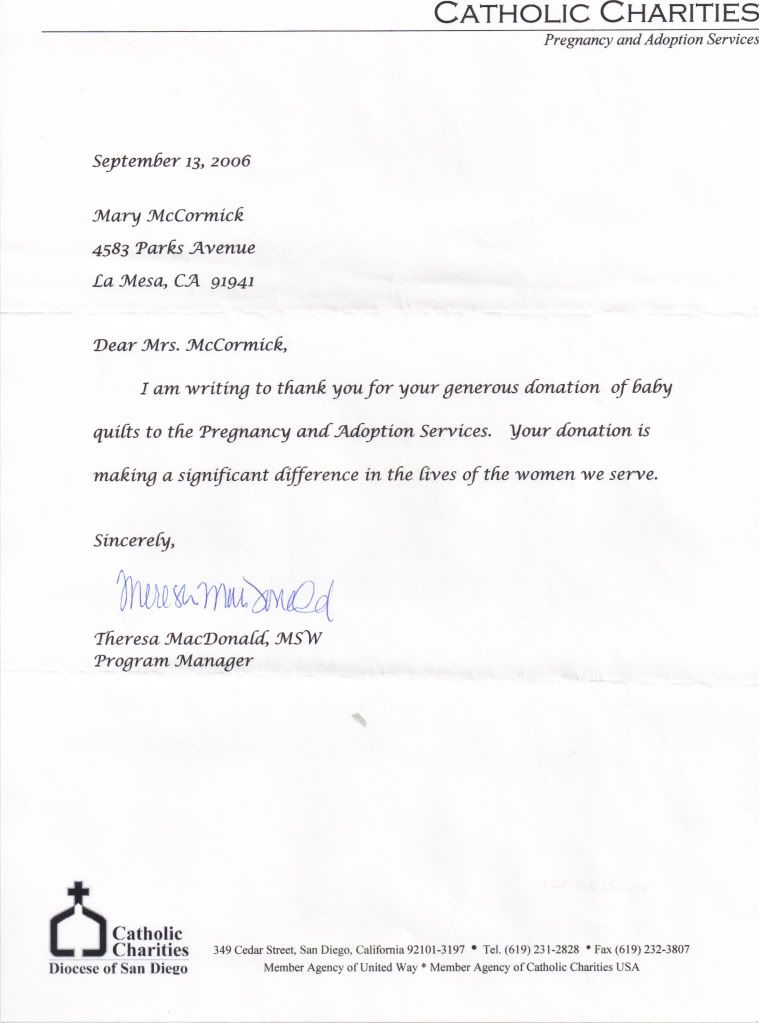
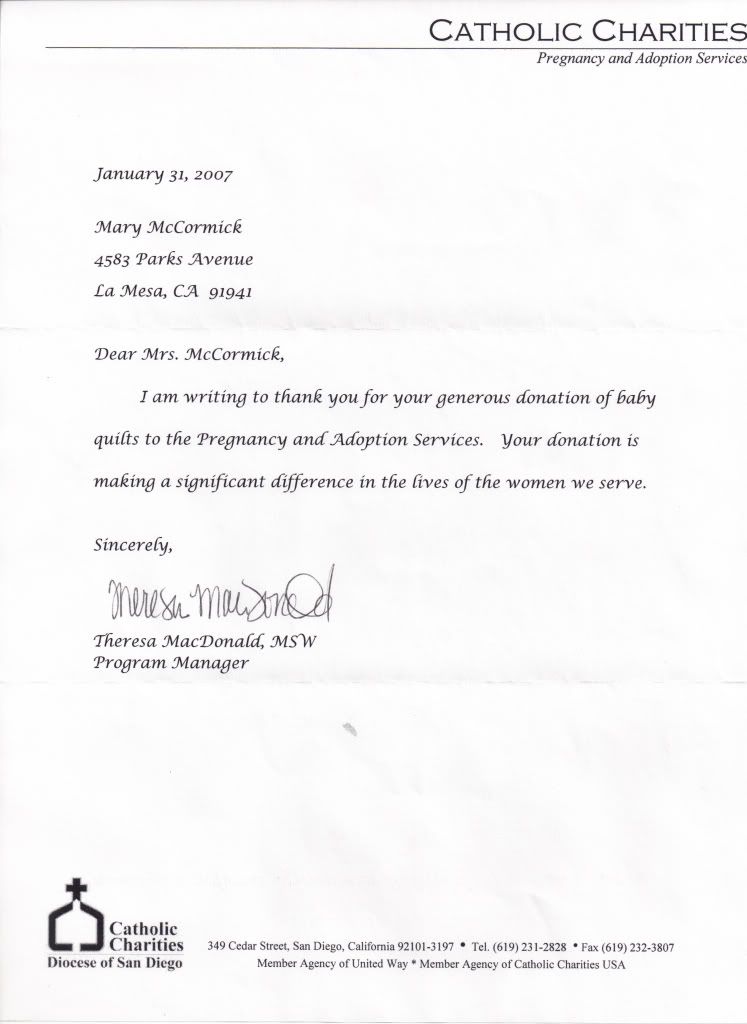
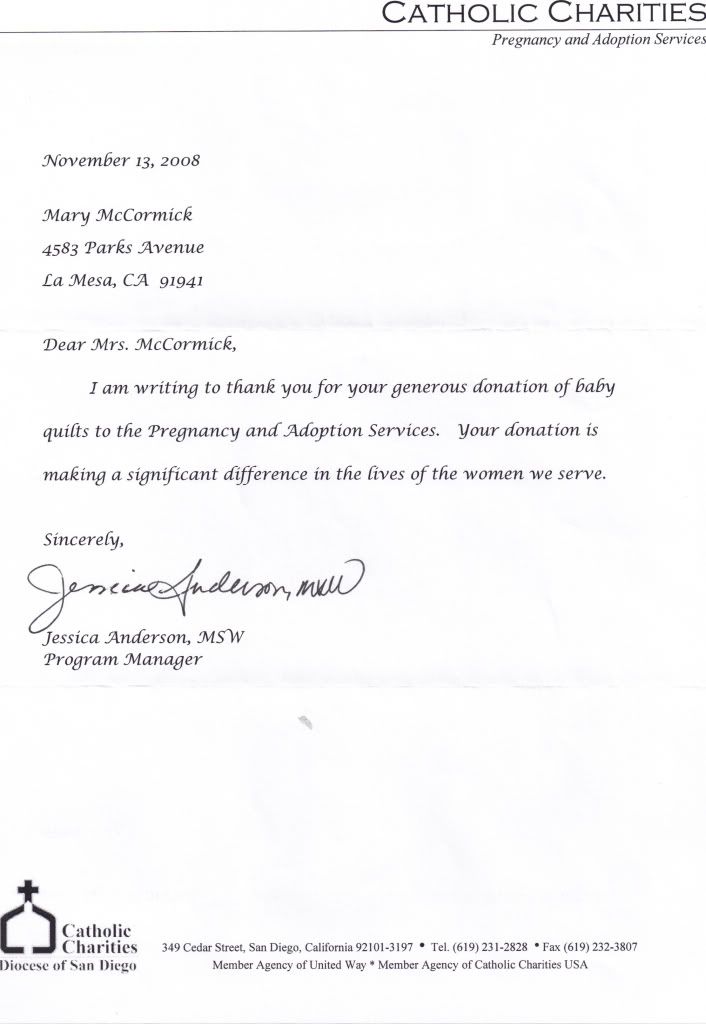
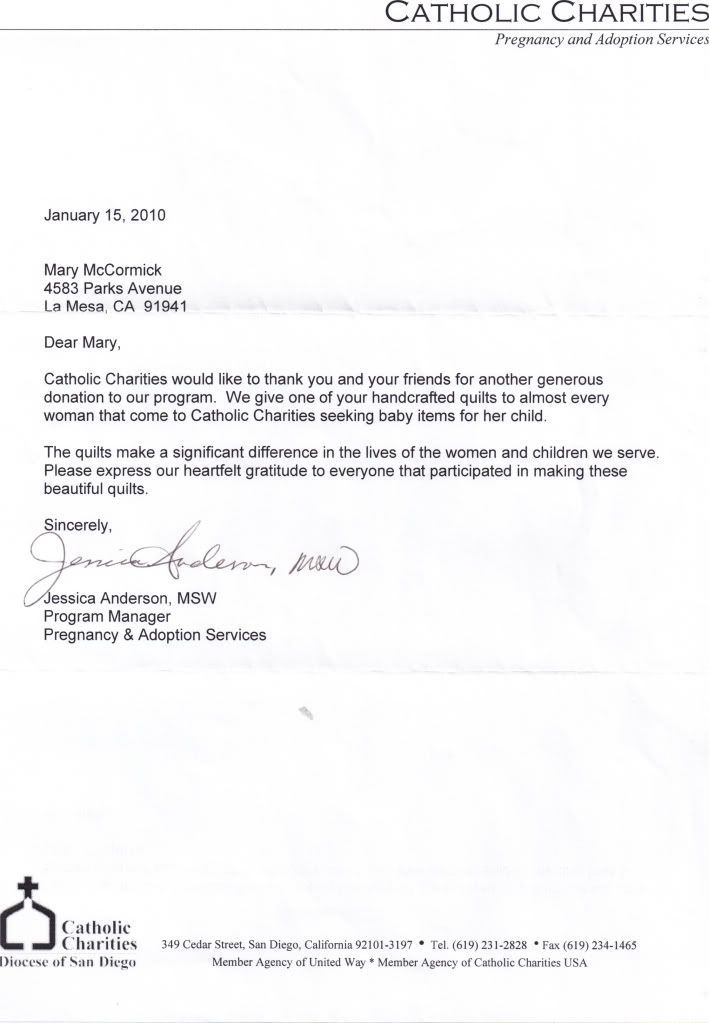
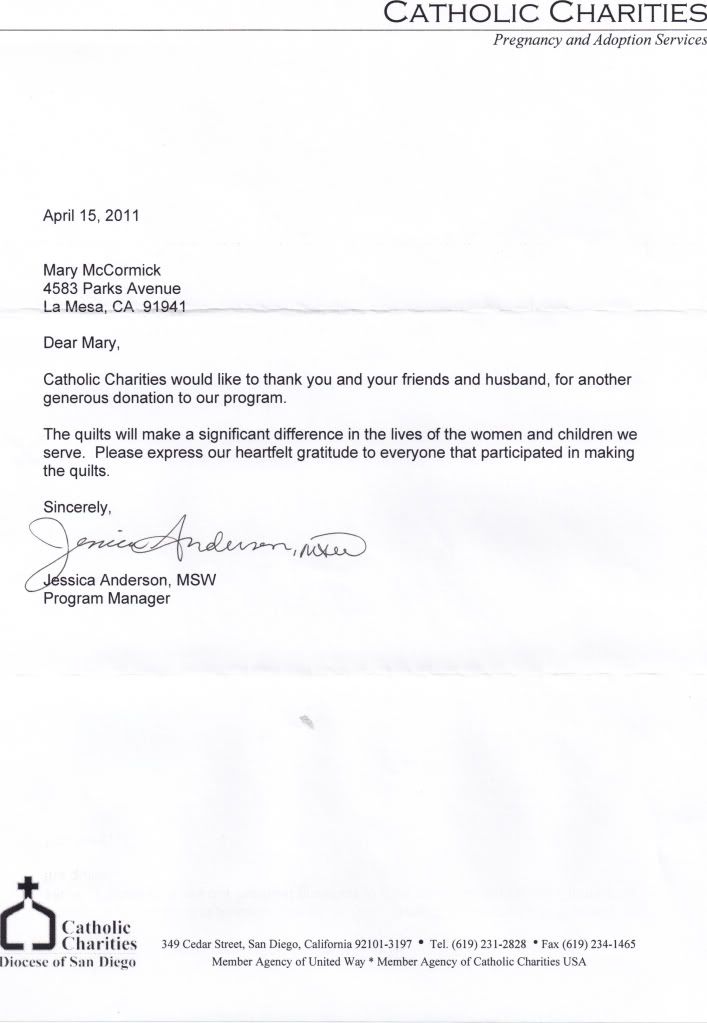
Mary Elaine McCormick, of La Mesa, passed away peacefully in her home at the age of 89. She was born in San Diego to Ben and Gertrude Hoffner. Mary graduated from Hoover High School and Santa Barbara State College. She married her high school sweetheart, Joe McCormick, on December 24, 1942 in Yuma, Arizona. Mary was a wonderful wife, mother and a loyal, giving friend. Mary enjoyed the outdoors as she and her husband traveled extensively in their motorhome and enjoyed many, many trips across the United States together. She was an avid gardener and talented seamstress who sewed many of her four children’s clothes as they were growing up. Mary, along with her quilting friends, made and donated thousands of baby quilts, bibs, knitted caps and booties for several local charities, including Catholic Charities, Polinsky Children’s Center and Sharp Mary Birch Hospital.
Mary is survived by her husband of over 68 years, Joe McCormick, four children John McCormick (Kathy), Trudie Keough (Tom), Marty McCormick (Leslie), Eileen Bird (Dan), nine grandchildren and five great-grandchildren.
The above facts in my mother’s obituary provide the major markers in a full and productive life but perhaps need some detail to better understand who she was as a person.Her father, Ben Hoffner, was a self made man who came to California at the age of 10 from Wisconsin. He became a backcountry ranger in the Sierra, who traveled his territory by horseback with a pack string. After marrying a school teacher in Ely Nevada, he gave up the freedom of the hills for a more steady job at North Island. He taught himself Greg shorthand and rose to be the civil servant head of the supply department for the base. He was a co-founder of the North Island Credit Union though he never had a high school education. He loved being outdoors and gardening was what he did after work. Vacations involved camping in the mountains and Mary enjoyed this very much, his wife not so much.
Mary’s passion for books and education were heavily influenced by her mother. Her graduation from Santa Barbara State College with a major in home economics probably reflected that influence. Mind you, the demographics of college graduation for women weremuch different in 1943.As an only child, she had the confidence to believe in her own judgment over the herd or anyone in authority. An example of that was when she went to a priest at Blessed Sacrament to get permission to marry Joe, who had joined the Army Air Corps at the start of World War II.The priest wanted my father to receive instruction because he wasn’t a Catholic. Mary said this was not possible because Joe only had three days of leave from pilot training. It became a contest of wills.Mary then made the ultimatum. If permission was not granted, she would get married outside the church. The priest wisely relented.All the family chipped in their gas coupons and Ben loaned his car so they could get married in a small church in Yuma.
The Parks street home in La Mesa was originally owned by her father Ben.A chicken farm was located close to it in the 1940’s and he used a wheelbarrow to bring the fertilizer to the back yard. Mary used this great soil as a starting point for her composting efforts. The back yard became the canvas for her artistry with growing things. In addition to avocado, tangerine, fig and apple fruit trees, she specialized in vegetables like beets, pod peas, potatoes, lettuce and chard. Mixed with the edibles came flowers for every season, orchids, perennials and annuals which kept the yard in color year round. Her excellent cooking skills made good use of the bounty produced by her organic and local approach to food production.
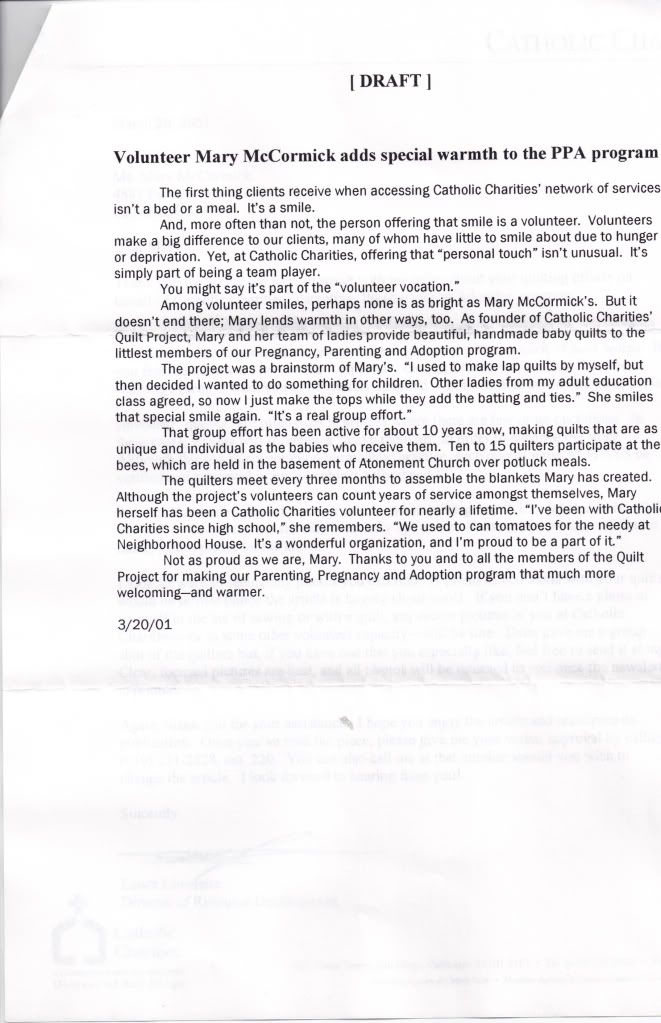
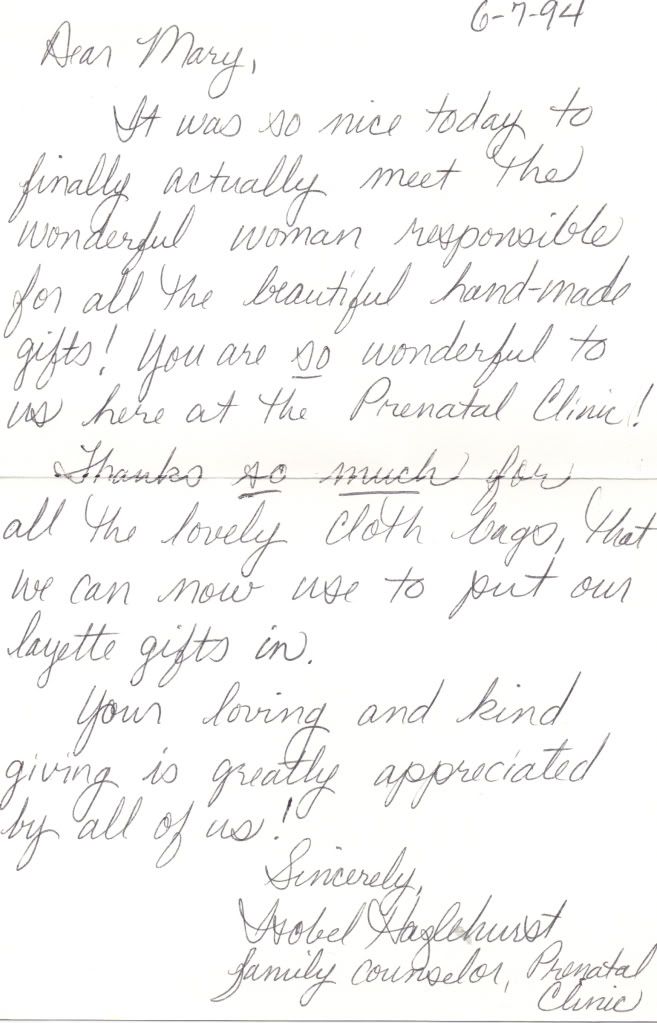
Mary was not the kind of person who talked about her religion, but rather acted it out in her daily life. One example of this was the quilting group she organized from friends made at various sewing classes. Groups of up to twenty women would come to the Parks Avenue home to sew and tie the quilts. A pot luck lunch would be the only interruption in their efforts. In her words “When I have made about 80 quilt tops I invite some friends from quilting class to meet at my house and we put the backing and batting and tops together by sewing machine.”These quilts were initially given to the home for unwed mothers at Blessed Sacrament in the early 90’s. As the production quantity increased, they were also given to the Polinsky Children’s Center, Sharp Memorial Hospital and Catholic Charities. This year the group got together in April and produced 400 quilts. These fine women showed by their good works the true meaning of charity and Christianity.
My mother was kind to others without being meddlesome. Even in the final stages of lung cancer, she had kind words for her caregivers. She was not a whiner and never complained about the gradual loss of freedom the disease made her fate. She refused palliative medication and died as she lived, on her own terms.
"The American way is to first feel good about yourself, and then feel good about others. But spiritual traditions say it's the other way around - that you develop a sense of goodness by giving of yourself." from Thomas Keating, Benedictine monk.
My mother and her friends have been providing blankets to Catholic Charities, Sharp Hospital, Grossmont Hospital, Polinsky Children's Center and Casa Maria for over 20 years. Their blankets make the daily routine of single moms and others a bit easier. My mother wrote a brief history of the project:
I first took a bunch of quilts to Blessed Sacrament Church for the women and children living there in the nun's house. This must have been in the late 80's or early 90's.
Later we started delivering the quilts to the current delivery location.
Donations of material, batting and thread come from many people: friends, quilting friends and from a quilt shop call Rosie's Calico Cupboard.
When I have made about 80 quilt tops I invite some friends from quilting class meet at my house and we put the backing and batting and tops together by sewing machine.
The quilts are then tied and stitched. At the end of the day some women take them home to tie them, as it takes a lot time tying them.
All of us work hard all morning then have timeout for a potluck lunch, then back to work.
During a year over 200 quilts are made for charity. This group of wonderful women enables us to make many quilts and some clothing for children. The quilts are usually crib size, which will be usable until age 5.
A big thanks to Kathy Green, who teaches quilting (and has taught for 27 years). She teaches adult education at Mt. Miguel, Foothills, and San Diego Community College.
The central thesis of David Brooks “The Social Animal” is that the linear, logical decision making part of ourselves is but an illusion and that our abilities to read the character and intention of others is at the core of our being. He describes a typical couple’s courtship and child raising through the eyes of current scientific evidence.
One of the factoids that hit home was that marital satisfaction is a U shaped curve. High satisfaction when first married, the low point when children are in adolescence and again a high point when the children leave. He cites an incredible wealth of data to support the depth of unconscious capability to foster bonding between mother and child. Of course, this bonding is kind of obvious, especially when the cold fact that the average mother loses 700 hours of sleep during the first year. And, more importantly, most of the greedy little guys and gals escape with their mother’s love unscathed.
He documents that there are critical exposures that influence motivation and passion. For me, one of those was the garage of Andy Anderson. It was on the street on the way to Saint Rose of Lima, where I walked to school most days. All kinds of weird antennas were about the house and I could see some kind of mysterious radio complex in the far corner. Mind you, this was way before cell phones and color TV.
I guess my age was close to eleven or twelve. Something about the mystery of being able to communicate with people around the world fascinated me. I got up the nerve to walk up the driveway and talk to Andy. He was a big man, perhaps six foot five and 250 pounds and an obvious leader of men. He told me in no uncertain terms that there was no future in my wanting to become a ham operator until I learned the Morse Code. I went home with my tail between my legs. How was I going to pass this juggernaut?
My mother consoled me and said we would learn the Morse Code together. My father, who was studying to be an electronics mechanic, used a j38 key, batteries and a buzzer from a door alarm to make a practice setup.
My mother studied the dots and dashes, which compose the letters of the Morse alphabet. She would send the characters hour after hour and I would dutifully decode them back to English.This was in addition to making meals, keeping the house and looking after the rest of my three siblings.
My father and I both passed our license exam, which consisted of code and electronics theory. David Brook’s book brought back some of the intense emotions that I felt when stymied by this hurdle of dots and dashes. It took a mother’s love to find a way for her son to reach his goal.
David Brooks makes this great thought. “If the outer mind highlights the power of the individual, the inner mind highlights the power of relationships and the invisible bonds between people. If the outer mind hungers for status, money and applause, the inner mind hungers for harmony and connections- those moments when self-consciousness fades away and a person is lost in a challenge, a cause, the love of another or the love of God.”
It seemed like the alarm didn’t go off. I looked at the clock and it was already 5 after 5. Not sure that I can make the 8:00 tram from Palm Springs. I had a great day yesterday sailing (link to sail), but in the evening had received a call concerning an email being circulated by a “friend” that tried to make me look like an idiot . The betrayal feeling was the emotion that led to sleeplessness, which in turn led to taking a sleeping pill and not hearing the alarm. Such is life. Kind of feeling low energy, but after getting some coffee was ready to make the 150 mile drive to the tram .
San Jacinto is on the South side of 10 as you go toward Palm Springs. It is 10,834 feet high and can be seen from San Diego or more easily from out at sea . Although there are many trails to the upper reaches from the West side, one shortcut is to take the Palm Springs Ariel Tram. It starts out at 2643 ft elevation And ends at 8516. It takes about 11 minutes to achieve this altitude. I like the tram.
Afra making sure that we are where we should be
It was very icy last week when Afra and I tried skiing up a new route that Dave had found. This route headed about 300 degrees from Round Valley. The trail to that valley from the tram is well defined, but runs up a creek bed and is usually rock hard. Snowshoe people usually avoid the trail like the plague and head directly up the steep but less icy Tamarack drainage. Afra is a very positive Dutch lady, who dismissed our struggles with the icy Round Valley trail as “good exercise”. She was sure that everything was going to loosen up with the coming sunshine. I was not so optimistic. At 10,000 feet it was getting more like boilerplate, so we called it a day. We could see the slopes of Jean Peak (link to Jean Peak ski) and San Jacinto, so the route was proven, without benefit of GPS. The edges sang or should I say shrieked on the way back, but no one got hurt and it was quite exciting.
I made the first tram , with a few minutes to spare. In the car were two rangers, one lady with her petrified kid, a fellow gray snowshoer, a snowshoe couple, and the tram operator. One ranger is giving a summary of the personnel experience levels, problems and a dismal report of the dangerous conditions on the mountain. I was glad to get off the tram before hearing more good news. We rushed down the ramp toward the ranger station, to pick up a permit. The ranger at the desk squinted with a frown when I told him the route was 300 degrees from Round Valley, but didn’t come right out and say that a solo hiker shouldn’t be doing this route. I had a plan to mitigate the risk, which involved a cell phone and my runner’s Garmin 201, which can get lat long on a position. Anything goes wrong, call in the lat long and wait for the sled. Unfortunately, the Garmin locked up on the tram ride and my cheap pay as you go phone never got service.
I was the first one up the trail with my microspikes (link to pictures of microspikes). I had wished all last week’s trip that my gear included these little wonders. At less than a pound, they go on and off easily and provide excellent grip on trail type steepness. With two poles for balance, they allow fast hiking on icy trails. My backup gear included snowshoes for deeper snow (never used) and an ice axe, in case you get somewhere that a fall will result in a slide for life. Going solo in icy conditions, I wanted to be on my feet rather than on skis.
Got the Garmin to reset by a sequence of frantic button smashing at Round Valley. It is at 9000 foot and it took about an hour from the ranger station. Didn’t bother with the compass, because the route just follows the contour up the right side of the valley, then heads West for a while and then back to a little break in the flank of Jean Peak. My personal problem has pretty much receded out of the picture. My footing is good and the Boreal mountain boots can penetrate into the steeper snow to provide good purchase. I try to breath in through my nose and accentuate the out breath through my lips. As it gets steeper, I do this with each step. One step breathe in, another step breathe out. The breathing at altitude is kind of a natural pranayama. The trees look healthy and tall. Their shadows provide harder snow, which makes progress easier. The more your feet sink, the slower you go and the more energy expended. Just like sailing in a light wind, you go back and forth rather than heading directly toward an objective.
I’m kind of wondering where everyone is. Last Sunday, we saw at least ten people on the flank of San Jacinto or close to this part of the circ valley defined by Jean Peak and the former. I haven’t seen anyone. Even the wind is quiet. It’s a little unnerving. I pass the prominent boulder we used for a backrest last week. I feel pretty strong, but stop and munch on a sandwich to be sure that there is enough fuel in the tank. Crossing over to the San Jacinto side of the valley, I look for some tracks to lead the way. I finally settle on some ski tracks, but when I start using them the footing slips out a bit. If I were with someone else, probably would ignore this little surge of adrenalin.
I’m thinking those old thoughts again. Why do I really need to go up this steep slope? It’s been a fun day, but is it really wise to do this alone? A person could get hurt up here. It looks too steep and there are some cliffed out parts with lots of rocks sticking out. Maybe I can come back next week with a friend. I stop while doing all this great thinking. My leg is starting to quiver a little from being in the same position too long. Then the other voice starts. You are 66 and something that you put off may not happen. I tentatively try breathing regularly while kicking the front of my boot into the slope to get more security on each step. I’m feeling better now and it really isn’t that steep or icy. A person could get hurt anywhere, if they don’t pay attention to what is going on around them. My confidence comes back and I’m just back in the present, trying to pick the best route up the flank.
At the top, the grade eases off. I’m at 10,450 and only another 400 feet of elevation to go. Starting to see all the development around Palm Springs, the mountains to the South, the beauty of the snow capped San Gorgonio. This was worth it. At the top, I take a quick peek over the edge toward the North, where the exposure is impressive down to the desert floor. It is seven miles and 10,000 feet to the desert floor, one of the steepest escarpments in North America.
North Face of San Jacinto
It is a little before 1 o’clock, about four and a half hours to the peak. The phone has no service here either, so much for that crutch. Time to start down. Going down is easier than I thought. These boots and microspikes work great. Most of the time a simple heel stomp will give good footing. On the icier parts, simply canting the boot into the slope and giving it a good emphasis at impact makes for a stable platform. A little sliding in the soft snow is OK, nothing out of control so far today.
Finding the little entrance into Round Valley is easier the second time. I’m making great time going downhill on the icy trail from the valley to the tram. Am back to the tram by 2:45, which means the zoo is in full production. However, everything has changed in a subtle but good way for me. I’m laughing at things that might on another day have given a smirk. It’s easy to be nice to people. It’s been a good day.
My grandfather on my mother's side was a backcountry ranger in King's Canyon in the Sierra. Ben was always ragging on me to do the John Muir trail. Because he was a horseman and "the man" in the mountains (note rifle in scabbard), I always looked up to him. While he was alive, I never did get to that challenge. My wife Kathy and I did about 100 miles of it last summer in two segments. They were Kearsarge Pass to Mt. Whitney and Piute Pass to Bishop Pass. We needed to do another segment this summer, and that was Kearsarge Pass North to Bishop Pass, a 61 mile stretch. Unfortunately, we have been having too much fun this summer and she only had two days leave to spare. On paper, the five passes only required four days if two of the passes could be done in one day.
On Thursday, August 12th, we drove separately up 395 to God's country. Our plan was to caravan to South Lake parking lot, leave one car and then drive back to Onion Valley to begin the hike. Because time was limited, we really needed to get over Kearsarge Pass that day to make the whole plan work. We kept in touch via FRS radios, so we could trade quips on other drivers or other sights along the way. The rest of the narrative is taken more or less from a crude diary that I struggled with each night before sleep.
8/12 Left San Diego at 5 AM with peanut butter sandwiches to be eaten as breakfast along the way. We beat the Norco traffic by a hair and arrived at the Lone Pine ranger station at 10:20, to pick up our wilderness permit. The ranger looked skeptical of our planned itinerary, probably because of my gray hair and impatient attitude. I assumed that we would be hiking by noon, what with our early arrival at Lone Pine. Yes, I thought that we had it sacked, but the car shuttle took longer than expected and we left the car at 1:30.
Onion Valley start
The tree of knowledge
Summited the Kearsarge Pass (11,760 ft elevation) at 5 . We were both pretty shot from the car ride and lack of acclimatization. We didn't have the luxury of sleeping at the trailhead, the way I like to ease into the mountains. Camped just above Charlotte Lake at about dark, after some discussion but no discord. We were too trashed to cook, but I tried to eat half a peanut butter sandwich. Kathy was bleary and had no appetite. As frequently happens at altitude, we were dead tired but wired in kind of perverse way, which made sleep elusive and never deep.
A beautiful day dawned and all was right with the world. Well, not really. To maximize time hiking, we were up on headlamps at 0530 to get organized and on the trail. We had an oatmeal packet and hit the trail at 0640 and arrived at Glen Pass (11,978 ft) at 0800.
Atop Glenn Pass
There is a rhythm to one's breathing that can really help at altitude. The in breath through the nose is metered on one step and the exhalation through pursed lips takes two steps. As with swimming, the important component of the breath cycle is the exhalation, as gravity takes care of most of the work on the in breath. Cardiologists say that the heart rate slightly increases on the inhalation and slows on the exhalation. Watching your breath is important to avoid headaches or worse.
The view of the Rae Lakes was spectacular. Unfortunately, the North side of the pass was very rocky, with big drop off steps being the rule. Also, the Rae Lakes were overrun with people. At our lunch break we realized that we had only covered 7 miles, not good. We ate a mega portion of salami and rye crackers, took a 15 minute nap and got going again. Our mood was a little somber. We were slow and tired, plus this was going to be a big push up a steep section to Pinchot Pass. We hit Woods Creek (the low point at 8547 ft) at 1:40. The worst part of the trip was the next 3.5 miles up to a nice campsite above a rushing creek. We made camp at 5:00, totally wasted. Kathy had a severe backache and my shoulders were trashed. We both were exhausted, but ate a freeze dried dinner and retreated from the mosquitoes at about 6:45. We slept like the dead.
Kathy putting up the tent
Crossing the South Fork of the King's River was a microcosm of being aware in the wilderness. On more difficult crossings, Kathy usually likes to ditch her shoes in favor of crocs and wade on the slick water stones of the creek bottom. I like to keep my shoes on and jump from available things sticking out of the water. I use the ninji toe socks, so it takes a while to get in and out of them. Because of my laziness and being tired, I made a stupid mistake and got my foot wet and still had to change to crocs after all. Little mistakes get magnified in the mountains. Wet socks means higher chance of blisters. Most accidents in the wilderness are not really accidents, just poor judgment.
8/14 We awoke just below the Sawmill Pass turnout, 3.7 miles from Pinchot Pass at 0530 and were on the trail by 0620. The upper area was a gradual incline. The meadows were inhabited by huge rabbits, who ran excitedly away from us. We made the pass at 0900. This was our chance to do two passes, Mather was only 9.5 miles away.
Mr. Rabbit near Pinchot Pass
We went through a beautiful lake filled valley and were making good time on the nearly flat terrain. Crossed the South Fork of the King's River at 1100. The trail gradually gained altitude through beautiful meadows bursting with flowers. At the upper end of the valley Mather Pass could be seen, an imposing wall of rock. Marmonts dominate the upper reaches of this valley of creeks. Made the summit after using amazing switchbacks cut from the rock face. It was 4:00 and we had time to spare to negotiate the poor trail full of rocks and big step downs. We found an excellent remote campsite above the Palisade Lakes on a windy ridge. Freeze dried food never tasted so good. We retreated to the tent after treating Kath's blister and a motrin for her back pain. What a great day over the best pass of the trip.
On Mather Pass looking South
Charger coach Don Coryell related in an interview that he did his best thinking on backpacks in the Sierra. There is something about the physicality of hiking at high altitude which frees the mind of its usual preoccupations. As I get to old age, the responsibilities of parenthood and work recede. All that is left is what I am able to do, how I treat people and whether I can accept what comes down the pike.
View from tent above Palisade Lakes
8/15 We woke up on the Lord's day at 0530 and were on the trail at 0620. Kathy and I were some distance above Palisade Lakes and this day proved to be a long one. The morning was spectacular and the "Golden Staircase" beckoned to us as the sun dawned. We saw a few deer close to the Middle Fork Junction. We had some salami and crackers there at 1130. The next three miles were uphill and Kathy's back began hurting rather badly. She also had a few large blisters. Things were looking bleak for our making Dusy Basin by this evening.
We met a couple of climbers at the Bishop Pass turnoff. One kindly gave Kathy a few Advil, which helped enough for us to make it to the lower Dusy Basin by 5:00. We found a great campsite, which overlooked the spectacular drop off down to the Le Conte Canyon. We spent a delightful half an hour at the sunlit creek, washing up and soaking our feet in the fast moving water. I stayed out in my running shorts until the sun went down, while Kathy rested her sore back in the tent. We are in a good position to make it the 8 miles to the South Lake parking lot before noon. Hoping for a good morning view from Bishop Pass.
Camp at Dusy Basin
Soaking our feet, Looking toward Le Conte Canyon
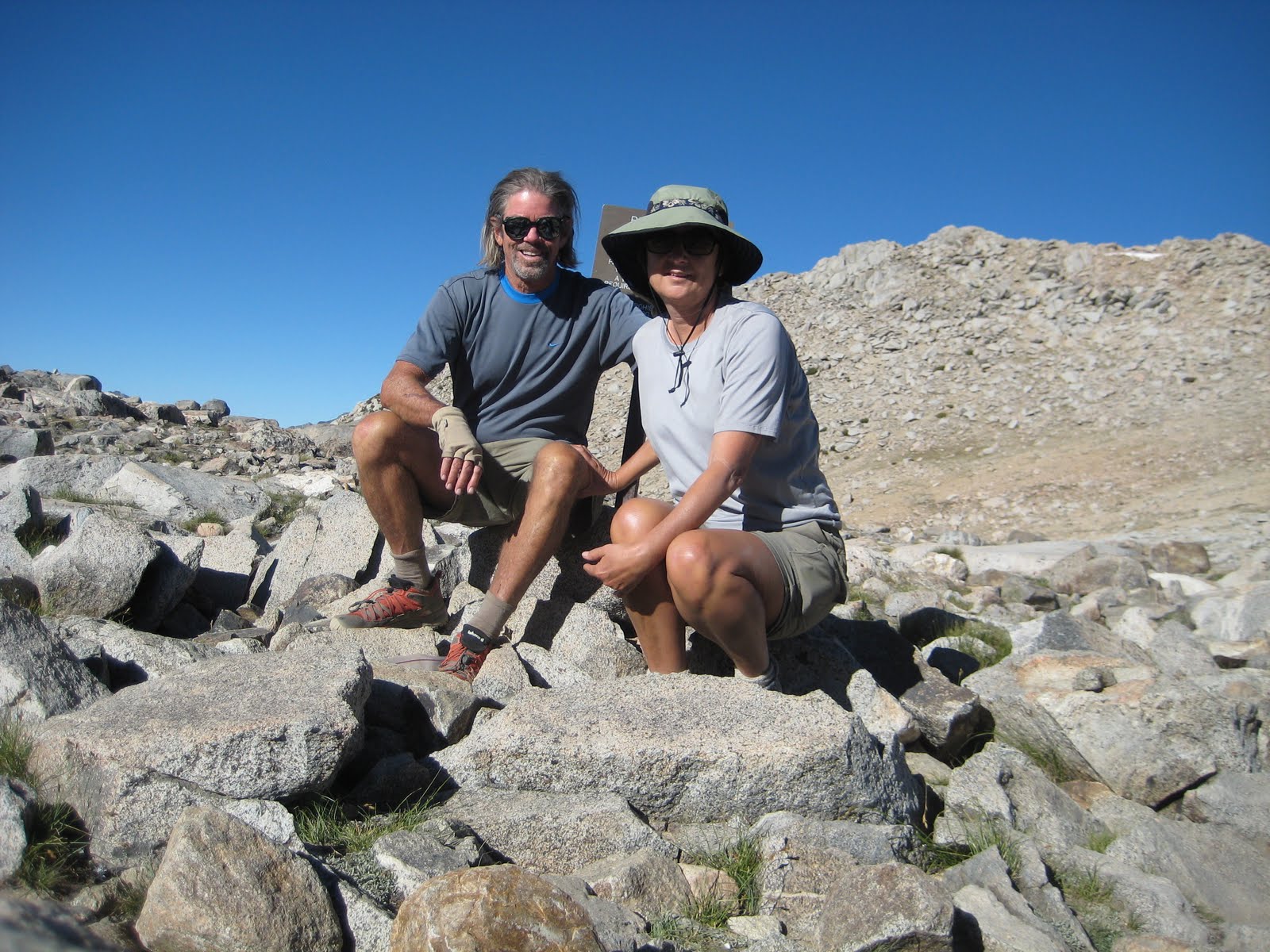
8/16 Made it to the Bishop Pass by 0900 and took the obligatory pictures by the sign. Had a nice hike down to the parking lot and have to say that it felt pretty good to be on our way home to San Diego after an action packed 3 days and 22 hours. Kathy and I honestly never had a cross word. I think my grandpa would have been proud.
I was one of the replacements who arrived after the NORTH AFRICA CAMPAIGN and left before the BRENNER PASS MISSIONS. I have no notes or records of individual missions, so I give you what I remember.I arrived in August 1943 and departed in May 1944.
In 1941, I was attending U.C. Davis and my future wife, Mary, was attending Santa Barbara State College, both in California. One weekend, my classmate George and I decided to hitchhike to Santa Barbara and visit the gals. On the way home we were picked up by a young man in a convertible who had on a pretty pink and green uniform. We asked what it was and he said he was in the Army Air Corps. He did a sales job on us and when we returned to school we decided to go to Sacramento and take the cadet exam. We both passed!!!!!
I had preflight Santa Ana, primary in Tulare, CA (PT-17) and basic in Lancaster, CA ( BT-13, BT-15). Then I went on to Roswell, NM for advanced (AT-9, AT-17 and B-25). We were class 43-D graduates.
(While at Lancaster, I had a three-day pass over Christmas. Mary and I used that time to borrow her dad's car and go to Yuma, AZ and got married on Christmas Eve 1942).
Joe and Mary McCormick (1942)
Combat crews were formed at RTU in Florence, SC and I was assigned as copilot on Marty O'Toole's crew.
There were a lot of newly-married 2nd Lts and for the training time there we were not allowed to live off base. We faked it with improvised ID cards and lived off base until one day we got caught and met the Base Exec to discuss it!!!
Not long after that we were on a cross-country flight to Tampa and lost a prop seal and had to lay over. Marty O'Toole, Joe Meredith (instructor bombardier) and I were out after curfew and got caught by a 2nd Lt MP. He seemed nice enough and said he would not report us if we went straight back to our hotel; however, he needed our names in case we were caught later that night. About three weeks later Marty, Joe and I were told to report to the Base Exec's office. Never trust a 2nd Lt MP!!
We went overseas via the southern route riding on ATC planes and were dropped off in Rabat French Morocco for further training.Mostly fun flying without rules!!!ATC ride then to Sicily.
During my combat tour of about 10 months and 57 missions we operated from 5 different fields and every field has its own character.
I picked up my nickname "SPIDER" along the way because I was a very skinny---6' 3"tall and when I was in the cockpit all they could see were arms and legs.
CATANIA:
We arrived at a camp on the beach with bushes all around the tents after dark. One of the guys meeting us turned out to be a classmate from my high school (DAVID MAYES-more about him at San Pan).
We were flying support for the British 8th Army and Capt Shealy, our adjutant, got us attached for rations: Tea, mutton, all that good stuff and a bottle of gin and scotch for each man.
The group was mainly flying support for the Salenero Invasion of Italy at this time.
My first mission was as copilot for Capt Fete on a night mission to the Naples Area. We flew as individual ships and you could see the flashes as the ships in front of us entered the target area, minutes and minutes of fear building. We lost one ship that night near Mt. Etna, the crew bailed out and was OK except the pilot Fred Blaney was killed.
After a few missions with John Fete and Peter Bunce, I was given Capt Fete's plane "I'LL TAKE YOU HOME AGAIN KATHLEEN" and began as pilot. The beachhead was secure and we moved to San Pancratzio on the heel of the boot known as ITALY.
SAN PANCRATZIO:
This field had a short concrete runway cut through a vineyard, which was good and bad. The hard surface was great, but with a full bomb load on long missions it was possible to pick up vines in the nacelles when the wheels came up as you lifted off.
This field had a few pillboxes from the Italian or German army using the field before us. David Mayes and a couple of others were going to take over one to live in. They sprayed 100-octane gas in it to get rid of the bugs. One of them lit a cigarette and there were some bad burns from that, Dave was evacuated to the states.
The good part of the place was there was an underground vat of DAGO RED--- all clubs had plenty of VINO !!!
One mission to Athens was a long one: It was a mass effort with many groups and a long way to go. We flew nine ship formations at that time and I was flying #2 on the lead ship of the squadron and after takeoff we had to climb thru the overcast to reach our assigned altitude. As we rejoined above the overcast, we were behind schedule and the lead ship was trying to catch up.As we came off the target we were still behind and the lead ship was still trying to catch up. My gauges were telling me my fuel situation was such that I thought we would not make it to our home field.I knew the 8th and 9th slot guys were in worse shape fuel wise. I tried to get the attention of the lead ship to get them to throttle back to conserve fuel, to no avail. So I unlocked the gun switch, fired a burst to get his attention. I then peeled out of formation and went into long range cruise. I caught it from the operations officer when we got back.
On another mission, we were joining up and I came in too fast, chopped the throttles and attempted to slow the critter down. The bottom dropped out and I lost 4000 feet before I recovered. I aborted and returned home. Upon reviewing it later, I thought it was a high-speed stall; however, Capt Nafe, the engineering officer, thought it might be a rigging problem so he and I went up and I tried to recreate the situation, no luck.
The bomb line was moving north so they decided we had to get closer to the action: Orders came to move to FOGGIA.
FOGGIA:
This is a flat area on the north side of Italy, the home of the 12th and 15th Air Forces Headquarters:
I flew my crew to the new field and we were supposed to meet the advance ground party at the new field, but they didn't show up. It was raining and cold so we put up a tent and waited for them to arrive. The tent only fell down once in the mud---what a day.
We had great quarters this time. The Italian government had erected many farmhouses along the main road. The houses had rooms upstairs and on the ground floor was the kitchen and stables with a cellar below.
About eight officers were assigned the top floor and the family lived below. At night the grandpa would invite us to sit around a bruiser of live coals and to share his vino.
There was an oval oven in the side yard and the lady of the house made pizza for us. My first pizza!!!
The missions continued, but one non-mission flying experience stuck in my mind:
The operations officer Capt Dozier told me a Colonel from one of the headquarters wanted to get in some flying time and I was selected to fly with him.
This old guy came out to the plane and I asked him if he wanted right or left seat? He said don't worry, Sonny, I take care of everything as he entered the left seat.
He started the engines-rolled to the end of the runway-pushed the throttles wide open- put two hands on the control column and we were away as I tried to clean up everything he overlooked in the cockpit. He tried some fun things like power-off stalls then we landed at a fighter strip. It was a P-51 Group and the C.O. pulled me aside and said "Get that S.O.B. out of here!!!" Right after we took off the colonel told me to take us home; I guess he had enough flying for the day
The Anzio invasion was the next business, so we had to get closer to the action: On to Pompeii.
POMPEII:
The field was tucked right next to Mt. VESUVIUS with Naples on the
other side of the mountain, and Anzio not far to the north. It made for some short missions.
There was a lot of history made in the area and we could go to Naples if we could borrow a jeep. One night we found an Italian military vehicle by the side of the road and towed it to the flight line. Rocky Petrozi, my crew chief, used it for transportation for awhile.
We had nice quarters again in a two-room house in a small village, six officers to a room. The family was close by to keep an eye on things. It had a flat roof and solid walls. Both items came in handy:
Solid Walls: We used a 100-octane gas heater for heat and cooking late-night snacks. One night the 5-gallon fuel tank overheated and it was shooting flame across the room like a flamethrower. We rushed in between blasts to get our things out. No damage---the solid earth walls saved the day.
Flat Roof: When MT VESUVIUS erupted, we woke up to six inches of wet ash on the roof—we had to shovel it off to keep the roof from falling in. Some of the ash was the size of footballs with a hot center.
Missions were short, supporting the ANZIO INVASION. Some missions were flown at 5000 feet—5 seconds to time the flak is not good.
I was scheduled to fly copilot with Lt Swope on the group lead on one mission and at the last minute the group commander, Col Jones, bumped me. They were lost over the target.
The new group commander, Col Chapman, lead the group to the end of the war.
One mission stood out: We caught a lot of flak and I was coming in too slow and too close following the ship in front of me. I got in bad prop wash and the right wing was pointing at the ground. My copilot (GAT Ross) jumped on the controls to help me. We overcorrected and landed on the left wheel, as we slowed down we ground looped because the right tire was shredded by flak.The luck of he Irish saved us.
I got sent to the ISLE OF CAPRI rest camp while in Pompeii.
While there I met a Navy Warrant Officer who was an engineering officer for a PT BOAT squadron in Tunis (He had worked for Packard Motor Car Co and the boats had two Packard V-12 engines in them).
He said if I got to Tunis, he would let me drive a PT BOAT if I would give him a ride in a B-25.
Mt Vesuvius erupted and the ash damaged all our planes and we moved by truck to Pastium.
PASTIUM:
It was back to tents again, no more of the good life. As it was in Pompeii, there was much to see in the area.
The missions were a little interesting because they picked up planes all over the Theater to replace those lost at Pompeii. Many planes were lacking armor plate and guns.
I took a ship to Tunis to have armor plate installed and I was able to look up the navy warrant officer that I met on Capri. He got his ride in a B-25 and I got to drive a PT-Boat. They had LST's as mother ships that had ice cream machines installed and we had real American ice cream with our meals. What a treat!!
The head shed decided it was time for us to move again, this time to leave the mainland of Italy and move to Corsica. The ground personnel got a boat ride and we flew our ships over.
CORSICA:
I was getting to the end of my tour, so I was thinking a lot about going home. Capt Dozier, the operations officer, had a new directive that set up a program where they exchanged ground combat troops and air corps crewmen so they would appreciate the other’s problems.
Not long after that I had an artillery major fly a mission with me and I was about to be placed on orders to go to the front lines. We discussed that and decided I was too close to the end of my tour, so they sent someone else. I think it was my friend Bill Laney (I met Bill at the Columbia Reunion in 1992 for the first time since WWII).
We got an R and R trip to Cairo, Egypt during this time and had a great time being tourists. Marty O'Toole was the pilot on that trip and I was the copilot---it was the first time we that been scheduled together since joining the squadron.
I finished my 57th mission in early May 1944 and was given the choice of flying a war weary B-25 to the states or going by troop ship. I chose to fly and went to Tunis to pickup an aircraft.
THE TRIP HOME:
I picked up a B-25G with some 75mm ammo still aboard. It was a pickup crew and the only one I knew was the Bombardier-Navigator, ED STOTLER from the 486TH.
My orders were to pick up the aircraft in Tunis and fly as a solo ship to Brooks Field in San Antonio, TX via the southern route.
Out of Marrakesh there was some weather over the mountains so we went around that and had no other problems except for not getting radio position or weather reports. No one aboard had any training in the 75mm gun so we dumped the ammo in a river to get rid of the weight before crossing the ocean.
Upon reaching Ascension Island we were met by a signal corps 2nd Lt and he asked me if he could talk to my radio operator. It seems my radio operator had been asking for weather reports for thirty minutes on the international distress frequency! It turned out the radioman had taken a short radio course in England so he could get on a combat crew. He never used the radio on his combat tour so he had forgotten a lot. I asked him why he didn't tell me his problem? He said I would have kicked him off the crew, which I would have. We laid over for three days and he was retrained and everyone was happy again.
We arrived in Miami and most of the crew was from the east coast so Ed Stotler and I decided to fly to Brooks Field without them and they could go home early.
Our first stop was New Orleans. We went to the Roosevelt Hotel and encountered a long room check-in line. We got in line and a hotel employee asked Ed if that was a purple heart he was wearing. Ed said yes it was, so we got immediate action on rooms.
The next day we were about 40 minutes out of New Orleans and lost an engine. We set down in an airfield in Lafayette, LA. An engineering officer flew up from the Lake Charles depot and signed for the plane. I took the train to Brooks Field to clear my orders.
I asked at Brooks flight operations if I could get a flight home to San Diego and they said if I was not returning overseas I had no priority and no priority, no flight. I took the train home.
HOME!!
It was great meeting everyone, especially my son JOHN who was born on March 12, 1944 while I was in Pompeii.
Joe John Don
While getting ready to go to the redistribution center in Santa Monica for tests and reassignment, I loaded the gas tank on Mary's 1939 Dodge coupe for the trip. The next morning I smelled gasoline fumes and looked under the car. The tank had been almost empty for a long time and weight of the added gas had caused the leaking.A mechanic came over and soldered a patch on the tank and the problem was solved.
The trip to Santa Monica was great--it was the honeymoon we had missed when we got married.
During the processing they asked where and what type of assignment I desired: I asked for the West Coast Area flying AT-11's or a similar plane.In the true army way they ordered me to Greenville, South Carolina as a B-25 instructor.
GREENVILLE:
We lived in a nice duplex, the owners were a nice old couple and they adopted us as part of their family. We were on a schedule of 24 hours on and 24 hours off; we had morning, afternoon and evening flight schedules and then a day off. We had three instructors from the 486th that I remember: Rocky Root, CJ Clarke and Ivan Olsen.
Ivan and I decided to try our hands at golf on our days off. We went to the Country Club and purchased a set of used clubs ($35 sounds about right).Mary pushed our son John around the course in a four-wheeled baby carriage to be with us. (To this day Mary says it is a silly game. John and I still play golf regularly.)
The flying was normal RTU stuff: instrument, cross country, bombing, skip bombing, gunnery and piloting skills.
We had one interesting event I remember quite vividly; there was a hurricane down south of us and the Navy was being evacuated to our air base. I was up with a student crew and the navy planes were using their carrier approach on landing. We were coming in faster and closing in too close behind the navy aircraft. The student kept getting closer and closer behind them and finally I took over. We aborted the landing; however, I think we broke some windows in the officers club in the process.
I arranged for a cross country trip to Monroe, LA.The Air Corps had the navigators school there. My younger brother DON was an aviation cadet in training at Monroe and I had not seen him in awhile.Fitting the B-25 into the AT-11 navigation planes traffic pattern reminded me of the recent Navy experience.Don and some of his buddies wanted a ride in a B-25, so I made their day with a short hop.The following is about my brother’s career:
First Lt. Donald W. McCormick, a 27-year-old native San Diegan, was a student at San Diego State when he was called to active duty in Korea in August 1950. He had previously attended Occidental College where he was a member of Alpha Tau Omega.
Don had served late in World War II as a B24 navigator but did not get into combat.
He completed a combat tour in Korea as a B26 navigator and was awarded Air Medals and a Distinguished Flying Cross for this service.After duty in Korea, Don entered pilot training and was killed in the crash of hisAT6 training plane at Bartow, Florida in May 1952.
The Air Corps had a points system to see who could be released from active duty and my number came up. Mary and I decided to leave the service. We were ordered to Camp Beale in Marysville, CA for discharge processing. I left the service on 3 Aug 1945.
I heard about the 57th Bomb Wing Reunions in 1979 and attended my first reunion in 1980 at Seattle.
I've always wanted to ski Mount Shasta. It's a long way from San Diego, but it like the Grand Tetons, a huge mountain scarp jutting up from a lower elevation plain. It's huge, and towers almost 10,000 feet above the small towns surrounding it. It's really a part of the Cascade Range , not the Sierra. When the ski section offered this trip, how could I refuse? It always is easier to do something new with people who have been there.
The way group ski trips work is a plan made months in advance. The weather can be good or bad, but airline tickets are purchased ahead of time and housing booked. I don't like being confined with a group much, so I opted for driving up in my camper. Since I bought a pair of skis online from a guy in Bishop, the planned route was going to be 395 to 44 to 89. I would mount the "new" skis in Bishop, then get an early day at Mammoth and continue on.
Arrived at the Lone Pine Visitor Center and tried to take a nap. Some inner city field trip parked next door and I was fading in and out with the interruptions. Was glad when they left, but then discovered a note on my truck telling me that the back camper lights were on and "Have a blessed day". Wow, better watch my karma or I'll be a grumpy old man.
The weather report looked dismal, but what the heck, I've got 4WD and I wanted to ski those light skis with some AT binders. Picked up the Goode skis at a residence that had a perfect view of Mount Tom, covered in snow.
As I was almost frantically mounting the bindings in the park parking lot at Bishop, I noticed two things. First, I had chosen an area that seemed to be frequented by teens and early 20's males on the hunt for Friday's fuel for party. Hope the cops don't think I'm dealing. Second, it was getting very cold in a hurry.
The Pleasant Valley campground is close to Bishop and is cheap. As the night progressed, the wind started moving the camper on the gusts. This is not good.
The day dawned with storm clouds and rain. Going up Sherwin Grade, it began to snow in earnest. By Mammoth, any hopes of skiing there or June were out. The snow was blowing sideways at something over 40 MPH. Not seeing too many pilgrims on this road. Thinking maybe I should reinforce my already flaky reputation by taking the prudent course and turning tail back to San Diego. But then started thinking that I wanted to ski with Afra and Dave, who had done Janet Peak with me and didn't want to let them down. It would later turn out that this was wasted altruism. Well, not completely altruism because I am 66 and how many more chances at Shasta am I going to get?
I have some experience with driving in snowy conditions. The main concept is to almost never use the brakes. The Dodge diesel makes this job easier, but the rig weighs over 10,500 pounds. Trying to anticipate things ahead and pretty focused on the bad weather and wondering if this is a bad decision. There are quite a few small towns as one gets to the East of Tahoe, slowing down the progress. But the scenery is really great and the snow makes everything look magical. I'm pretty well shot by the time I get to Honey Lake, just before Susanville. After an aborted run looking for a free campground up to where the dirt road got very bad, and then the hejira ended with a road closed sign. Elected to get off the road a bit at the Honey Lake RV place. It was $16 without hookups, nice people and a great view. I'm dry camping in the RV because water in the holding tanks would be a disaster. It's in the 20's and our handy film strip LP gas reader doesn't work like in the desert. Elect not to run the heater, want to have a way to cook.
I sleep like the dead and wake up and it's still blowing, but not snowing like last night. My portable radio gets a station in Susanville and they are talking chains and ice in town. It is 28 at 7, and 29 at 8. The weather forecast is for snow at 11, so the plan is to leave at 9, to maximize my chance of the ice being gone and still have time for the toughest part of the trip, highway 44, before the snow starts in earnest. Also, there is the sad news that climbers got caught in the storm on Sunday and one has died. The recovery helo can't get off today because of bad weather. I am no longer thinking about skiing, just want to get the truck back in one piece.
Briefly on highway 36, then at the beginning of 44 there is a sign saying "Speed Limit 35 MPH, chains required". Since I had screwed my back up checking the water level in the camper battery for the first time, I hadn't practiced putting these particular chains on the truck. What the heck, I'm not turning back at this point. Slow down to 45 and proceed. The road is in bad shape, lots of patches of snow and snow and ice. Had read the owners manual last night on 4WD and am able to put it in and out of real 4WD while going at any speed. This really is a good rig in bad conditions.
It is very exciting and beautiful. The trees are flocked with snow and everything looks fresh and free of the usual desecrations of man. I'm actually starting to enjoy this. Going in and out of 4WD and using the gears to slow down when necessary. No problema!
It's kind of anticlimactic to get to highway 89, which is more heavily used road. The road is mostly just wet with occasional patches of snow on dark curves. It does start snowing at 11, but no big deal. I'm turning into the Mount Shasta Ski Park by noon. It is Wednesday, so seniors get the $15 ski deal. It's kind of like Big Bear, only there are only twenty cars in the parking lot. I get used to the skis and bindings and am a happy camper.
Mount Shasta, the town, is a sleepy new age spot with a number of inns, restaurants and tourist shops. I get some propane and find out there were two gallons left, so I could have run the heater last night. Find our little 100 year old house above the Radio Shack storefront. It it very nice and there is a good parking spot behind the property. The rental is filled with little notes to remind the the user of his responsibilities and potential hazards that lurk in this abode to the ignorant and stupid. The owners have definitely been there done that and are prepared for the worst.
It has a great view of the tattoo parlor and liquor store. I am happy to walk around in a regular house, drink tea and read "The Future of Freedon" by Fareed Zakaria. His central focus is an analysis of those critical components of viable and long lasting democracies. He points out that the mere pretense of elections is a necessary but not sufficient condition for one that is viable. For instance, Hitler was elected in a supposed democracy. Fear has a funny way of making people give up their freedoms to get the trains to run on time.
The group is a strong one. Patty, who arranged the trip, is of Norweigen descent and is both pleasant and at the same time tough as nails. She has skis that are kind of skinny, but she always gets to the high point. Dan has literally written a book on skiing SoCal and is great company, with a dry humor that is not to be missed. Big Mike has taught more people to ski than anyone else in San Diego and is very competent and knowledgeable. Dave is both a skier and a dancer and kind of merges the two disciplines in the backcountry. All these people are always ready, on time, packed and ready to ski. I'm fortunate to have them as friends. We added two new friends, Myrek and Ann. Myrek escaped from Checkoslovakia, just before the Russian crackdown. He has great stories, is very generous and has a powerful athleticism about him. Ann is great to be around.
The lockbox had the wrong combo on the info sheet. I had worked out the problem with the landlord but had to wait for the others to arrive so the info could be passed on. By the time they arrived (without my friend Afra), I decided that it was way too crowded and elected to retreat to my Lance Camper cell.
At 0800 we are sort of prepared to go. We go up in the rented van and the day looks pristine. The mountain has a good road up to Bunny Flats at 6900 feet. There is a restroom and a large parking lot, where I will park my camper next time. The view is spectacular right out of the car.
The new AT setup and the light carbon fiber skis are working great, using some narrow skins (synthetic pile with adhesive on one side) to get a little glide going uphill. I have some wider skins for when the climb stiffens up. I am not worried about avalanches down here in the lower reaches because the snow looks pretty consolidated, but he headwall that Avalanche Gulch approaches gives me that old fear response. It has been snowing for four days and now its warm.
We get to about the Sierra Club cabin. Dan and I wait for the others. The whomp whomp whomp of the recovery helo is the only sound in the wilderness. It sounds like a military exhaust but probably is a big Bell high altitude helo. After a beacon exercise, the others head up canyon and I stay behind to do some terrain further down. It is pretty crowded compared to somewhere like San Jacinto or San Gorgonio because most of the terrain has been stripped of trees from previous avalanches. You can see people camped on ridgetops, skiing with dogs and generally having a great time.
By the time the others return, it is time to head back to the car. The gulley we ascended looks like a half pipe and I go from side to side, gaining momentum and at one point shouting "hully gully". It is great fun, but I'm back to the car too soon. What a great place to come and play.
The next morning, no one wants to ski so, I head back on highway 5. It's snowing pretty hard in town and on the highway, for about an hour or two. Thirteen and a half hours and I'm back home, with a one hour nap in the middle of the trip. Mission accomplished, the hard way. Next time it is going to be highway 5 to the parking lot at Bunny Flat.